


What the 2025 survey results reveal about momentum and why services are accelerating.
Momentum matters—and in services, momentum compounds.
Last fall, I examined the structural rise of services within direct selling and outlined why recurring value, ownership alignment and scalable platforms were reshaping the channel. The 2025 Services Companies Quick Poll results now show that those structural forces have intensified.
The scale is larger. The equity participation is deeper. The demographic reach is broader. The technological investment is more advanced.
Services are no longer emerging within the channel. They are expanding at scale—anchored firmly in the US market, which represents approximately 95 percent of service revenue in the broader North American region. In fact, only one company in the data set, Exit Realty, is based in Canada.
If last fall’s reports and research identified the shift, this year’s data confirms that the shift has matured into sustained acceleration.
Services by the Numbers
This year’s Quick Poll surveyed 29 US-based service companies and one Canadian company with at least $100 million in annual revenue—double the $50 million ARR threshold used in the product companies report.
Company reports combined with independent research place the US services segment at approximately $35 billion in annual revenue. The directional results are clear:
- 90% demonstrated year-over-year growth based on company reporting and independent research
- 50% achieved defined momentum growth
- 10% reported declines
For purposes of this analysis, momentum growth is defined as year-over-year expansion of 20 percent or a minimum of $200 million in annual revenue growth.
The 50 percent cohort—companies growing 20 percent or more or adding substantial revenue—is the group highlighted throughout this report and represents a historically strong concentration of measurable momentum.
In a service-driven model built on recurring value and long-term relationships, having nine out of ten companies growing—and half delivering measurable momentum—is a powerful signal of structural strength.
Within this data set, performance was directional—companies either grew or declined. Importantly, this growth is overwhelmingly domestic. With very few exceptions, non-US revenue was not material to overall performance. The momentum we’re seeing is driven by the United States market—steady, recurring and relationship based.
Where Service Momentum is Concentrated
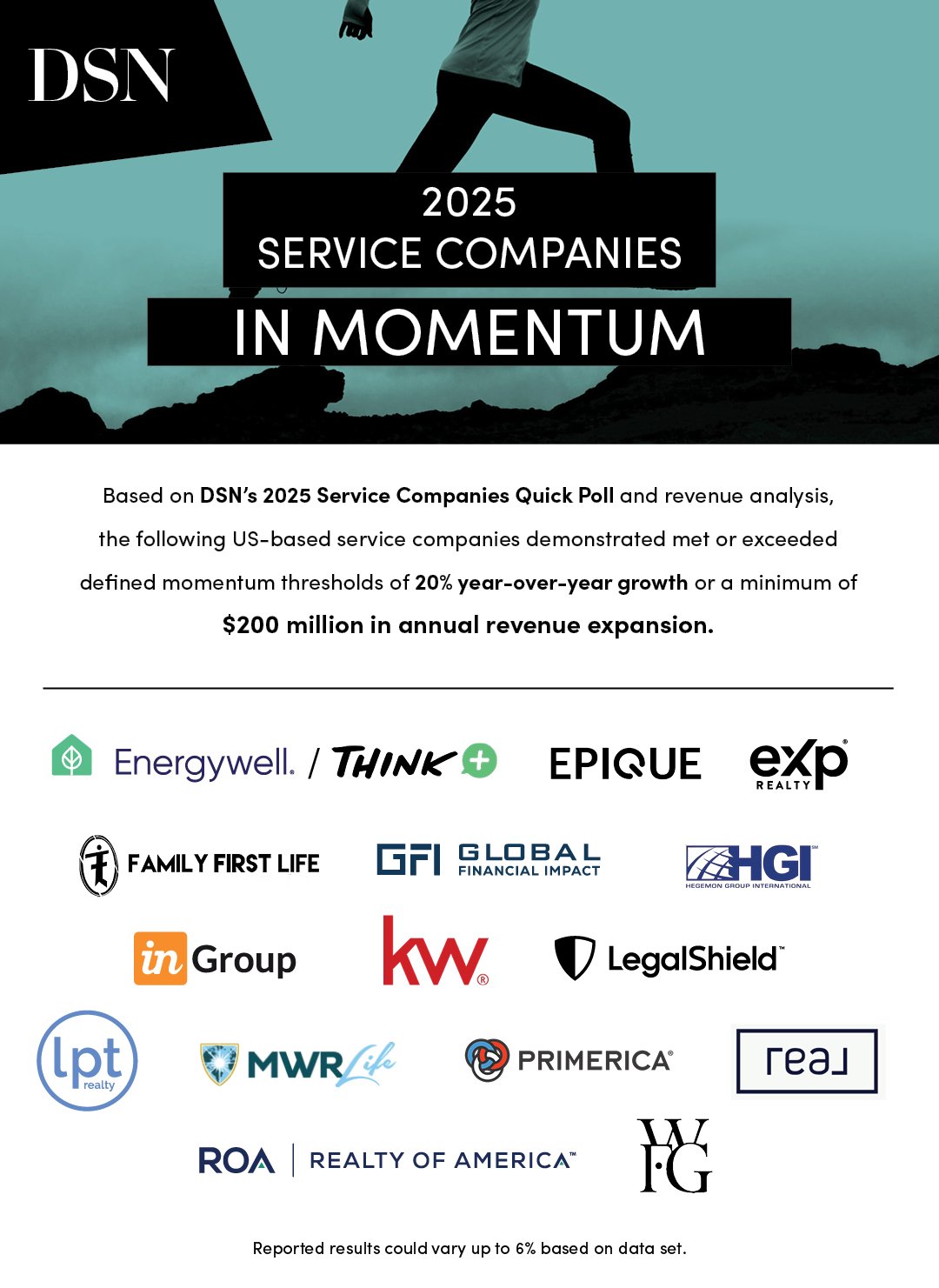
The companies demonstrating the strongest momentum span real estate, financial services, legal protection, energy and lifestyle platforms—categories where recurring value and ongoing relationships are fundamental.
On the real estate side, companies such as eXp Realty (NASDAQ: EXPI), Keller Williams, REAL Brokerage (NASDAQ: REAX), LPT Realty, Epique Realty and Realty of America/ROA continue to show velocity driven by agent-centric platforms, profit share, revenue share, equity participation and scalable technology.
These businesses benefit not only from transaction volume, but from community effects—agents recruiting agents, sharing expertise and building durable networks.
Critical to long-term network cohesion and alignment within many of these platforms is the issuance of restricted stock units (RSUs) and other equity-linked incentives to agents—structures that deepen loyalty and reinforce shared enterprise growth.
Financial services organizations are also prominent among the momentum leaders. Companies including Primerica (NYSE: PRI), World Financial Group (NYSE: AEG), Family First Life, Global Financial Impact and Hegemon Group have benefited from renewed consumer focus on protection, planning and long-term financial confidence.
Other service categories are contributing meaningfully as well. LegalShield continues to demonstrate the strength of subscription-based legal and identity protection services. Energywell/Think+ highlights how everyday utility services can be successfully distributed through relationship-driven models. inGroupand MWR Life show how lifestyle and travel services can generate engagement through membership and community rather than one-time transactions.
Outside the US, Utility Warehouse (LSE: TEP) in the United Kingdom has achieved extraordinary results by consolidating essential household services—energy, broadband and mobile—into a single, simplified monthly bill.
And while not currently in material momentum, no discussion of the energy market would be complete without recognizing the long-term and significant contributions of Ambit at its 20th anniversary and ACN at more than 30 years in operation.
Momentum Among the Established
Conventional wisdom suggests that momentum is typically driven by younger companies. In many categories, that is often true. But services tell a different story. While a handful of younger platforms appear on this year’s momentum list, the majority of companies demonstrating substantial growth are well established—and in several cases, decades old.
Among the real estate platforms in momentum, only three—LPT Realty, Epique Realty and Realty of America (ROA)—have been operating for fewer than six years. The remainder have far longer histories, including Keller Williams, which has been in business for more than four decades.
The pattern is even more pronounced in financial services. With the exception of Global Financial Impact, the momentum companies in this category are all more than 10 years old—some significantly so. Primerica, for example, has been operating for nearly 50 years.
Even among established platforms, scale continues to expand meaningfully. MWR Life surpassed $100 million last year, and inGroup grew almost $100 million in the travel space to reach $350 million—demonstrating that mature service platforms are not plateauing; they are accelerating.
Scale at Speed: The Rise of Emerging Companies
While the majority of momentum companies are well established, the scale achieved by newer entrants is equally notable.
In real estate, LPT Realty is approaching $700 million in annual sales. Realty of America (ROA) crossed the $100 million threshold in its first calendar year, and Epique Realty is also in momentum. These are not incremental startups—they are scaled platforms achieving rapid velocity.
The same pattern appears in financial services. Global Financial Impact has experienced rapid revenue growth in its first two years.
And on the broader list, Energywell/Think+ approached $150 million in its third year.
The longevity of the established leaders is impressive. But the speed at which these emerging platforms have reached scale is equally significant. Services momentum today is being driven by both maturity and velocity.
Scale Requires Context: What Revenue Really Represents
To fully understand services momentum, revenue must be contextualized.
Real estate companies report only the commission revenue they receive—not the full property transaction value. The underlying transaction volume moving through these platforms is approximately 30 times greater than reported revenue, representing well over half a trillion dollars in annual US transaction value.
Insurance and financial services companies report only the premiums and commissions they collect—not the face value of policies or the total coverage provided. In the case of financial investment products, the revenue from financial investment products represents the fees only and not the actual investments.
As a result, the true economic impact of these organizations is significantly understated by reported revenue figures. Services revenue is significant, but its underlying economic footprint is exponentially larger.
Equity Participation Drives Structural Growth
One of the most important accelerants of service momentum is equity participation—and it is more embedded across platforms than ever before.
As outlined in our previous reporting, ownership alignment changes behavior. When agents and advisors participate in equity, revenue share and enterprise value, the relationship shifts from transactional to generational. Independent contractors become stakeholders.
In real estate, stock incentives, revenue sharing and ownership participation are redefining recruiting and retention dynamics. In financial services, aggregation strategies and equity-aligned distribution models are strengthening enterprise durability and long-term alignment.
This is not merely a compensation detail. It is a structural mechanism that shapes culture. Shared rewards foster shared success. Field priorities shift from next month’s commission to long-term enterprise value—driving cooperation, retention and a more stable foundation for growth.
Equity participation creates wealth pathways beyond commissions, reinforces loyalty and deepens commitment to platform growth. It is increasingly clear that ownership alignment is not merely correlated with momentum—it is materially driving it.
In fact, less than 10 percent of real estate professionals operate within modern cloud-based, revenue-sharing/equity-aligned brokerage models—a structure that has existed for little more than 15 years—yet these platforms represent the fastest-growing segment of the industry.
Demographic Reach Is Expanding the Growth Base
Another defining driver of service acceleration is demographic reach. Service platforms are demonstrating strong penetration across African American, Asian American, Hispanic/Latino and many other growing demographic communities across the United States.
Demographic expansion is not limited to ethnicity. A significant and growing portion of service platform growth is being driven by professionals under the age of 35. In financial services in particular, the under-35 segment now represents a dominant and expanding share of new recruiting and field growth. In real estate, the trend is present but less pronounced—emerging steadily rather than leading the category outright.
At a recent Family First Life event, more than 7,000 attendees gathered with an average age under 30—an indicator of how dramatically the age profile differs from traditional product-based direct selling models. Equally notable was the broad ethnic diversity represented in the audience, reflecting the expanding demographic reach of modern service platforms across African American, Hispanic/Latino, Asian American and many other communities.
At a time when younger independent workers have more entrepreneurial options than ever—across digital products, ecommerce, trading platforms and gig models such as Uber—many are gravitating toward the professional status, long-term value proposition and community structure of services-focused social commerce.
We are witnessing a broader trend toward the professionalization of social commerce—centered increasingly around higher-ticket service offerings that require education, licensing and long-term client relationships.
These models provide accessible entry points, flexible entrepreneurial pathways and recurring income potential—combined increasingly with ownership participation. That alignment resonates strongly in communities seeking economic mobility and long-term wealth creation.
The result is measurable recruiting velocity and retention strength across diverse markets. This demographic diversification broadens the base of services growth and strengthens long-term sustainability. Services are not simply expanding in scale—they are expanding in reach.
Technology Is Now Infrastructure
Technology is playing an increasingly central role in services momentum as well. The scale achieved by leading service companies has enabled substantial investment in proprietary internal platforms, onboarding systems, transaction management tools, compliance infrastructure and AI-enabled efficiencies.
Compliance oversight is integrated. Training modules are digitized. Recruiting systems are leveraged through integrated platforms. Productivity metrics operate in real time. These investments are not cosmetic enhancements—they are structural advantages.
Technology now functions as infrastructure. It enables scale, improves margins, accelerates onboarding and enhances customer experience. It widens the competitive gap between established service platforms and smaller competitors without comparable investment capacity.
Why Services Continue to Win
Services align naturally with how consumers live today. They solve ongoing needs rather than episodic ones. They allow representatives to focus on education, trust and long-term engagement—rather than constant product replacement.
Recurring services—energy, legal access, identity protection, utilities, travel memberships and financial planning—create predictable revenue streams and durable customer relationships. Recurring value creates recurring revenue. Recurring revenue creates stability. Stability enables reinvestment.
Real estate operates differently—but it is recurring at scale. While a home transaction is episodic for an individual consumer, mobility within the broader population creates consistent transaction velocity. Buyers become sellers. Sellers become buyers. Families relocate. Investors transact repeatedly.
At scale, real estate functions as a relationship-driven recurring business—even if the cadence differs from subscription-based models. Referrals from prior clients further compound transaction velocity, reinforcing real estate’s long-term relationship-driven economics.
Simply put, services create relationships. And relationships create momentum.
Looking Ahead
As we move through 2026, four primary forces will continue shaping services momentum:
- Economic normalization after inflationary pressure
- Increased competition, particularly from hybrid and platform-based models
- Expanding equity participation across distribution networks
- Artificial intelligence reshaping service delivery, personalization and customer engagement
AI will not replace relationships—but it will amplify them. The companies best positioned for the future are already using data to improve onboarding, training and customer experience at scale.
Increasingly, time-intensive administrative tasks—contracts, compliance oversight and documentation—are automated or system-managed as value-added support for agents and representatives, freeing them to focus on client relationships and revenue-generating activity.
US Services Revenue on Track to Double by 2030
Based on current structural drivers—equity participation, demographic expansion, technological investment and recurring value models—I believe US service revenue will double again by 2030. That projection implies a compounded annual growth rate of only 15 percent—ambitious, but well within reach given the momentum already visible in the segment.
New players entering emerging service categories—and innovation within both new and existing models—will be a material part of that expansion. At approximately $35 billion today, the segment’s trajectory suggests sustained, structural expansion—not cyclical fluctuation.
Your Key Takeaway
DSN’s 2025 Service Companies Quick Poll makes one point unmistakably clear. Services are not a secondary category within direct selling. They are a rapidly expanding, ownership-driven, technology-enabled growth engine firmly anchored in the US market.
When 90 percent of companies are growing—and 50 percent are achieving defined momentum—the signal is not subtle, it’s structural.

STUART JOHNSON, Founder & CEO, Direct Selling News, has served the direct selling industry for 40 years. His passion for the channel encompasses a broader commitment to build and connect the direct selling community through exclusive industry events such as Direct Selling University and the DSN Global Celebration. Stuart is arguably the most connected person in direct selling. He has built an impressive and growing network of executives, thought leaders, strategists and innovators. His advice and counsel are sought after by leaders throughout the channel.
An Online Exclusive from Direct Selling News magazine.
The post Service Companies Quick Poll Results first appeared on Direct Selling News.