
Digging deeper into what it means for direct selling right now.
In the months following our initial discussion of social commerce, I have continued to approach this topic not as a trend to be observed, but as a system to be understood. That distinction matters, particularly in a channel where behavior often precedes language.
That process has involved conversations with executives, consultants, platform experts and thought leaders working at the intersection of content, community and transaction. I am grateful to those who contributed their thinking, including Fractional CMO Kathleen Ross and several industry sources who are actively operating in this space. Their perspectives reinforce a central idea: before we determine how to respond to social commerce, we need to be precise about what it is—and equally precise about what it isn’t.
Our first article established a working definition. This article continues the conversation. The question for this channel is no longer definitional. It is directional. What matters now is understanding what social commerce represents in practice; how it aligns with the underlying principles of direct selling; and what leadership teams should be doing in response.
What Social Commerce Actually Is
There remains a tendency to reduce social commerce to a set of tactics—posting content, sharing links or hosting live streams. While those activities are part of the ecosystem, they do not define it. Framing social commerce that way risks treating it as an extension of marketing, when it represents a shift in how the customer journey now takes place.
As Kathleen explains, “Social commerce recognizes that the entire customer journey—from discovery and recommendation through purchase—is increasingly taking place within a social environment.”
That distinction is more than semantics. In traditional ecommerce, discovery happens in one place; evaluation in another; purchase in yet a third. Social commerce compresses those steps into a single environment, often within a single platform. The conversation, the recommendation and the transaction are no longer separated by design. They exist in a continuous flow. That shift changes not just where transactions happen, but how they are influenced.
For many areas of retail, this represents a meaningful departure from established patterns. For direct selling, it should feel far more familiar, because the channel has always operated in a space where trust and transaction are closely linked.
The Spectrum of Social Commerce
For leaders new to the concept, it is important to recognize that social commerce does not operate in a single, fixed format. It exists on a spectrum.
On one end, a distributor’s content—such as an Instagram Reel or short-form video—drives discovery, and the customer completes the purchase through a company website. On the other end, some organizations have established direct platform integrations where the entire transaction occurs within the social environment itself.
Most direct selling companies fall somewhere in between these two extremes, combining social-driven discovery with traditional purchasing pathways. All these scenarios represent social commerce. Understanding that range is essential, because it allows companies to engage with the model progressively rather than feeling pressure to adopt a single, fully integrated approach.
The Kitchen Table, Reimagined
Direct selling has historically taken place in environments defined by proximity and trust. Whether in a home, a small group setting or a one-on-one conversation, the structure of the interaction allowed for storytelling, demonstration and relationship-building to drive purchasing decisions.
The defining characteristic was not the setting itself, but the dynamic within it: people making decisions based on trust in the person presenting the product.
What’s happening now is not the replacement of that dynamic, but its expansion. As one industry source working closely with field-driven social commerce activity described it, the kitchen table did not disappear—it moved into the digital feed.
That shift is significant not because it changes how people buy, but because it dramatically changes how many people can be reached within a single interaction. A conversation that once extended to a small group can now extend to a much broader audience without losing the relational context that makes it effective.
Kathleen reinforces this continuity, noting that “direct selling has always been built on personal recommendations and trust. Social commerce is the connective tissue that closes the loop.”
In that sense, social commerce is not introducing a new model of behavior. It is scaling an existing one, allowing the same trust-based interactions to occur in environments that are more fluid, more visible and significantly larger in reach.
Why It’s Accelerating
The speed at which social commerce is developing is not the result of a single innovation, but of several forces that have been building independently and are now reinforcing each other. At the center of that convergence is a shift in consumer behavior. Increasingly, people are relying on recommendations, demonstrations and shared experiences rather than traditional forms of advertising.
This shift is not theoretical. Research from Boston Consulting Group shows that social media influencers have become the top source of purchasing influence, surpassing traditional search and advertising. At the same time, more than 80 percent of consumers now use social platforms as part of their product research process. These behaviors are not emerging—they are already embedded in how customers discover and evaluate products.
At the same time, platforms have invested heavily in infrastructure designed to support that behavior. Features such as in-app checkout, shoppable content and creator storefronts have reduced the friction between interest and purchase, allowing consumers to act on recommendations immediately rather than navigating through multiple steps.
Layered onto this is the rise of a creator economy, where individuals are not only influencing purchasing decisions but actively monetizing that influence. The result is an ecosystem where content, trust and transaction are increasingly interconnected.
This distinction matters. Social commerce is not a technology in search of adoption; it is a response to how consumers already prefer to discover and evaluate products.
Why Direct Selling Hesitates
Despite the alignment between social commerce and the core principles of direct selling, many executives continue to approach the topic with caution. The concerns that surface most frequently are not without merit. Questions around customer ownership, platform dependency, compensation integrity and compliance are grounded in real operational considerations.
Kathleen highlights one of the most immediate challenges when she notes that transactions occurring within social platforms often limit a company’s direct access to customer data. This introduces a layer of dependency that must be managed deliberately rather than ignored.
At the same time, many of the broader concerns stem from an assumption that social commerce represents a competing model rather than an adjacent one. That assumption tends to frame the conversation in terms of replacement—what is lost—rather than in terms of expansion—what is added.
Most of these concerns are not reasons to delay engagement. They are design considerations—and they can be addressed.
What Most Leaders Get Wrong
The most persistent misconception surrounding social commerce is the belief that it bypasses or replaces the distributor. In practice, the opposite dynamic is emerging. Social commerce is proving to be highly effective at expanding reach and accelerating product discovery at scale, but it does not eliminate the need for trust, education or community. Those functions remain central to the model and continue to be delivered through human relationships.

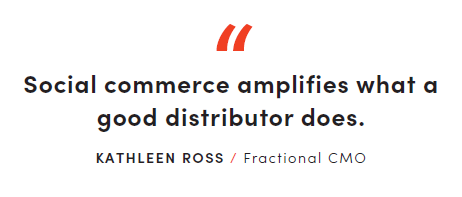
Kathleen addresses this directly, noting that “the fear that social commerce somehow replaces the need for a distributor—I actually think it’s the opposite. Social commerce amplifies what a good distributor does.”
What we are seeing is not a replacement dynamic, but a more integrated structure already taking shape across the market. Social commerce is not confined to discovery alone—it increasingly supports both acquisition and ongoing engagement, introducing products to new audiences while reinforcing continued interaction through content, community and repeat exposure.
The distributor relationship remains central, particularly in providing guidance, context and long-term connection, but it now operates alongside platform-driven touchpoints that influence both initial and repeat purchasing behavior.
Rather than separating acquisition and retention into distinct functions, social commerce is extending across the full customer journey—from initial discovery through ongoing engagement—often within the same environment. The opportunity for companies is not to assign these roles to different parts of the model, but to understand how they now overlap and reinforce each other.
When viewed through that lens, social commerce is not a disruption to the channel. It is a validation of the underlying principle that has always driven it: people buy from people they trust.
Where It’s Already Happening
One of the more important realizations for executive teams is that social commerce is not something that needs to be introduced into the model. In many cases, it is already present, operating across the field in ways that are not always fully recognized or measured.
Distributors are creating content, hosting live demonstrations, building audiences and driving product interest across multiple platforms. These activities are often treated as isolated efforts rather than as components of a broader system, but collectively they represent a meaningful level of participation in social commerce.
Kathleen captures this dynamic clearly when she observes that “these behaviors are already happening at scale. The question is whether the company has recognized it and built a strategy around it.”
This creates a situation where innovation is frequently occurring at the edge of the organization, driven by the field, while the systems designed to support and scale that innovation are still evolving. The gap between those two realities is where both opportunity and risk currently reside.
The Platform Reality
It is tempting to view social commerce through the lens of a single platform, particularly one that is receiving significant attention. That approach, however, tends to produce narrow strategies that are difficult to sustain.

TikTok currently represents one of the most integrated social commerce environments in the US market, but it is not the only one that matters, nor is it universally applicable across categories. Kathleen notes that “it would be a mistake to build a strategy around any single platform,” emphasizing the importance of understanding where products and audiences naturally align.
It is also important to recognize that TikTok is not the right fit for every category. Products that require deeper explanation, longer consideration cycles or more structured purchasing paths may perform better in environments that support more deliberate engagement.
For many direct selling organizations, Meta’s ecosystem remains a central environment simply because of the level of existing field activity. At the same time, other platforms contribute in different ways.
YouTube supports deeper product education and long-form trust-building, while affiliate and marketplace-driven environments like Amazon Live, LTK, ShopMy and TikTok Shop connect content directly to high-intent purchasing behavior.
Amazon Live operates differently because purchase intent is already present. Rather than driving discovery, it captures demand at the point of consideration, where customers are closer to deciding and conversion rates are typically higher.
In practice, the most effective strategies span multiple platforms rather than relying on one. Organizations that approach social commerce through a platform-specific lens will find themselves continually reacting to change. Those that focus instead on aligning product, audience and behavior across platforms will be better positioned to adapt as the ecosystem evolves.
What Leaders Should Be Doing Now
The response required at this stage is not a wholesale reinvention of the model, but a more deliberate alignment between what is already happening and how the organization is structured to support it.
In practical terms, this begins with visibility. Leadership teams need a clear understanding of how demand is being generated through social activity; how that demand is converting; and where the disconnects exist between field behavior and corporate infrastructure.
From there, the focus shifts to enablement. The foundational skills of direct selling—storytelling, demonstration and relationship-building—remain directly applicable, but the venues have changed. Communicating effectively in short-form video or live environments requires a different level of fluency, and that fluency must be developed intentionally—not assumed.
Equally important is the design of the path from content to transaction. Social commerce compresses time, reducing the distance between interest and action. When a customer is ready to purchase, the process must be immediate and intuitive. Friction at that moment does not simply delay conversion; it often prevents it entirely.
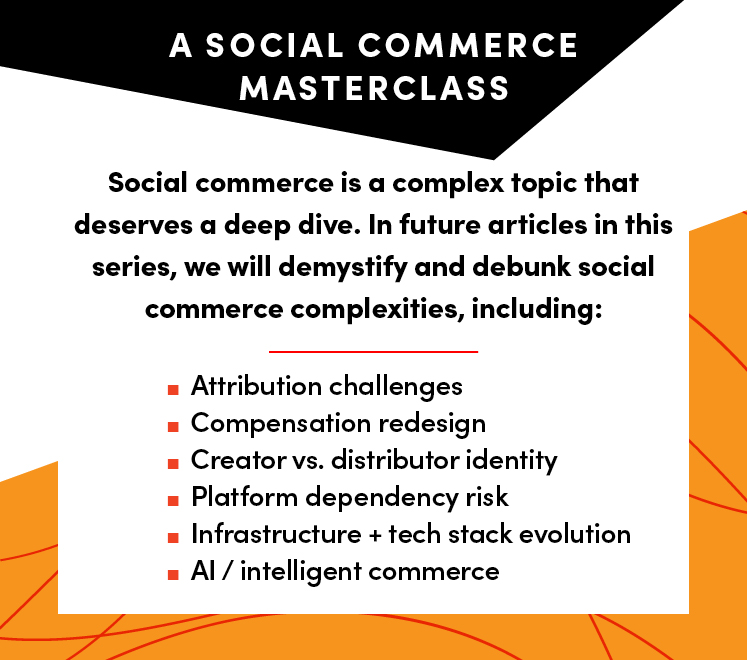
The most complex and, in many cases, least developed area is attribution. As interactions become more distributed across platforms, understanding how a specific piece of content or conversation leads to a transaction becomes more difficult. It also becomes more important, as compensation, motivation and strategic clarity rely on that understanding.
In more advanced implementations, companies are beginning to see how activity across platforms can reinforce each other—for example, how live shopping content can drive incremental demand in adjacent channels or how first-party data can be used to nurture customers after initial discovery.
Kathleen offers a practical perspective. “The field is already out there doing this. The fastest wins come from removing barriers for the people who are already active.”

Where This Is Going
Over time, the term “social commerce” will likely become less distinct, not because the concept will fade, but because it will become embedded in how commerce is generally understood. Consumers will move fluidly between content, conversation and transaction, often without distinguishing between them.
At the same time, the line between distributors, creators and influencers will continue to narrow. The underlying activity—building trust, creating content and recommending products—is already converging across those roles.
For direct selling, this evolution presents both a challenge and an opportunity. While systems and structures may need to adapt, the core competencies of the channel remain aligned with where commerce is heading.
The Real Question
Direct selling has always operated on a simple premise: relationships drive transactions. What is changing now is not that principle, but the environment in which those relationships are formed and expressed.
The shift we are witnessing is not from direct selling to social commerce. It is from a defined environment to a distributed one. Social commerce does not change the model. It extends it.
The question is no longer whether social commerce will shape the future of retail—it already is. The real question is whether direct selling companies will choose to lead that evolution or allow others to.
Where to Start—A Practical First 90-Day Focus
For executives looking to move from observation to action, the first step is not building something new—it is developing familiarity with how social commerce works. This begins with experiencing the platforms as a consumer: how products are discovered; how content drives interest; and how transactions occur within or alongside social environments. Without that perspective, strategy tends to be built on assumptions rather than experience.
From there, companies can begin developing clarity around what already exists internally. In most organizations, social commerce activity is already taking place across the field but is often fragmented and largely unmeasured.
A focused first phase should begin with a structured assessment of where and how distributors are engaging on social platforms. This includes:
- identifying which platforms are most active
- what types of content are generating engagement
- where product interest is being created
The goal is not to evaluate performance in detail, but to establish visibility into behavior that is already influencing the business.
From there, companies should identify a small group of field leaders who are already effective in these environments. These individuals can serve as both a learning resource and a testing ground for new tools, training and systems.
At the same time, it is important to evaluate the current path from content to transaction. How many steps exist between interest and purchase? Where are potential customers encountering friction? In a social commerce environment, even small barriers can significantly impact conversion.
Finally, leadership should begin mapping how social-driven activity connects to revenue. Attribution does not need to be perfect in the early stages, but there must be a deliberate effort to understand how demand generated through content translates into measurable outcomes.

STUART JOHNSON, Founder & CEO, Direct Selling News, has served the direct selling industry for nearly 40 years. His passion for the channel encompasses a broader commitment to build and connect the direct selling community through exclusive industry events such as Direct Selling University and the DSN Global Celebration. Stuart is arguably the most connected person in direct selling. He has built an impressive and growing network of executives, thought leaders, strategists and innovators. His advice and counsel are sought after by leaders throughout the channel.
An Online Exclusive from Direct Selling News magazine.
The post Social Commerce 101 first appeared on Direct Selling News.