
The shine is wearing off the gig economy. It’s time to fight for the relationship economy.
For years, direct selling executives have openly discussed the impact of gig-economy platforms and how they are potentially siphoning away a new generation of builders. After a decade of rapid adoption, I suggest that the shine of the gig-economy has worn thin.
The reality for many is that low variable pay, rising risks, algorithm destabilization and changing business models combine to create no path to asset value creation for gig workers. Factor in the impact of AI and the problems and pitfalls multiply.
In effect, the gig model has become what Canadian communications theorist Marshall McLuhan might call digital serfdom—you work land you don’t own, while the algorithm plays landlord. Freedom at the front end; dependency at the back.
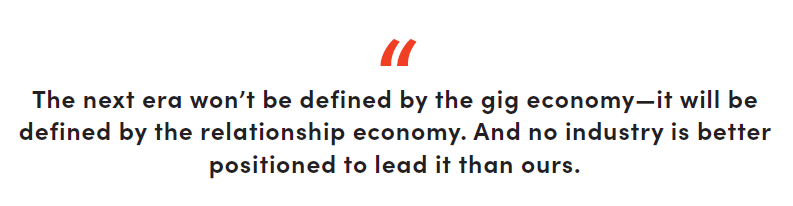
Now add AI accelerating us into an unsettling post-human marketplace, where authentic human interaction becomes the rarest commodity. This is why the next era won’t be defined by the gig economy—it will be defined by the relationship economy. And no industry is better positioned to lead it than ours.
Industry legend John T. Fleming captured this potential in The Ultimate Gig, reminding us that direct selling gives ordinary people extraordinary opportunities to design a life, not just earn a living. The post-gig era doesn’t discard Fleming’s vision—it reaffirms it.
The Gig Economy’s Appeal
We ignore the appeal of gig work at our peril. People choose Uber, DoorDash and other platforms for reasons direct selling can learn from: simplicity, speed and a low barrier to entry. Gig work is “easy to start, easy to quit.”
That’s a signal. If the relationship economy is to win talent, we must match that frictionless entry while adding relational depth and compounding value.
Consider that more than 36 percent of US workers have engaged in gig work, yet Gallup and Pew consistently show they report higher dissatisfaction with income stability and career prospects than those in traditional or entrepreneurial roles.
This dissatisfaction creates an opening. Direct selling can position itself not as another short-term hustle, but as a sustainable path for people hungry for flexibility with future upside.
Freeing People from Digital Serfdom
In the gig model, workers own nothing. They have no customers, no transferable assets and no compounding effect for their efforts. They rent their time by the task, and once the ride ends or the delivery is dropped off, so does the income. This transactional treadmill produces activity, but not prosperity.

In the relationship economy, value compounds. People build networks of customers and advocates who trust them, follow them and refer others. That trust becomes a renewable asset—one that generates income beyond the individual transaction. A relationship-driven business lets people step off the treadmill and onto a track that actually goes somewhere.
What Gig Platforms Got Right—and What We Must Do Better
Uber didn’t win because it was sexy. It won because it was brutally simple: download the app, open an account, drive, earn. That’s what relentless simplicity looks like.
For our channel, the lesson is clear: simplicity is not superficial, it’s structural. Every unnecessary click, form or step is friction. In the gig world, people just walk away. In ours, they stall on day one. To compete in the post-gig era, we must:
- Deliver Relentless Simplicity
Systems so intuitive that new people don’t stall on day one. - Reduce Cognitive Load
Shorten the path from onboarding to first income. Overwhelmed people don’t slow down, they stop. - Remove Administrative Burden
Leaders highest and best use is investing their time on income-producing and network-building activities, not chasing paperwork.
Gig platforms taught consumers to expect frictionless experiences. If we don’t meet that standard, they’ll walk. But when we do—and then add compounding relationships, belief and community—our value proposition outpaces the gig model all day long.
This is our version of Uber-simple—compounding value gig platforms will never provide.
Why Relationship Marketing Outperforms the Gig Model
Gig work rents time. Relationship marketing builds equity. The difference is profound.
- Repeat Purchases = Repeat Pay
Loyal customers buy again—and you get paid again. - Team Leverage without Employees
Builders who grow teams multiply output without multiplying hours. - Ownership vs. Dependency
You own the customer relationship and distribution network, not just a rented slot in someone else’s app. - The Ripple Effect of Advocacy
Not every happy customer becomes a distributor, but advocates share stories, make referrals and extend trust into new circles.
A Tetradic Lens for Better Decisions
McLuhan’s tetradic framework helps leaders anticipate both intended and unintended effects of innovation:
- Enhance: What value does this increase for sellers and customers?
- Obsolesce: What outdated steps does it remove?
- Retrieve: What timeless strengths—community, mentorship, recognition—does it revive?
- Reverse: If pushed too far, does it replace human connection with automation?
Think of it as four questions every executive should always ask ourselves: What are we really building here? Are our new technologies and programs reinforcing trust and community? Are we introducing innovations that simplify life for the field or are we layering on complexity?
The tetrad reminds us that every choice has trade-offs. By approaching change with curiosity rather than assumption, leaders can capture the upside of innovation without losing what sets direct selling apart.

From ROI to ROR in an AI World
ROI is necessary but incomplete. The Relationship Economy runs on Return on Relationship (ROR): the compounding value of trust, loyalty and influence.
AI can and should strip away cognitive load and administrative burden, freeing the field to focus where ROR is created—human connection.
As AI thought leader Dan Debnam explains, “AI won’t replace people. People who use AI will replace those who don’t.” AI allows humans to do the work that only they can—building deep, lasting, productive long-term relationships that drive business and profit.
The Four Pillars of Belief—Our True Competitive Moat
Industry veteran Paul Goundry believes that for sustained success to be achieved in the Relationship Economy it depends on belief—specifically, four interconnected pillars that gig models and AI can’t replicate.

- Belief in the company. Vision, mission, brand reputation and leadership.
- Belief in the opportunity. Confidence that the plan rewards effort fairly, not just the very top.
- Belief in themselves. People must see they can succeed with coaching and support.
- Belief that they are valued. Recognition, care and community. Knowing that a healthy, inspiring community backs them is liquid gold.
Executives should regularly audit their organizations against these four pillars. A wobble in one weakens the structure. When all four are strong, belief compounds just as income does.
Framing the Future
The post-gig landscape presents both challenge and opportunity. Millions are searching not just for flexible work, but for meaningful work—connection, recognition and the chance to build something lasting.
Direct selling is uniquely positioned to offer that—if leaders frame the opportunity with clarity and conviction. By applying the tetradic lens and strengthening the four pillars of belief, we can make the relationship economy not just an alternative to gigs, but the obvious superior choice.
Don’t let direct selling be mistaken for just another hustle. Gig work rents time; relationships build futures. The companies that communicate that distinction with boldness and consistency will define the next era of growth.

MICHAEL CODY is the Chief Operating Officer of Genistar Limited, the UK’s fastest-growing financial education and services brand, serving 145,000+ families with nearly £13 billion worth of policies in force. He began his career in the field at 19 and has since held senior leadership roles, including COO of AquaSource. He is passionate about helping people step off the gig treadmill and into businesses that create lasting value through community, leverage and financial education.
The post Winning the Post-Gig Economy first appeared on Direct Selling News.